What it is, how it is done, who it may help, who should avoid it, and what the research actually shows
| At a glance – Ketamine is a long-established anesthetic. At much lower doses it can reduce suicidality and other depressive symptoms faster than standard antidepressants . – In ketamine-assisted psychotherapy, the medicine is combined with structured therapy: preparation before, support during, and “integration” sessions afterwards. – The strongest evidence is for treatment-resistant depression and for rapidly reducing suicidal thoughts. Evidence for PTSD and addiction is promising but smaller. – Benefits often fade within days to weeks unless treatment is repeated and backed by ongoing care. It is not a one-session cure. – It is not suitable for everyone – uncontrolled blood pressure, psychosis, current mania, pregnancy and active ketamine misuse are the main reasons to avoid it. |
What is ketamine?
| In short: An anesthetic used safely for over 60 years. In small doses, it can lift depressive symptoms and suicidality in faster. |
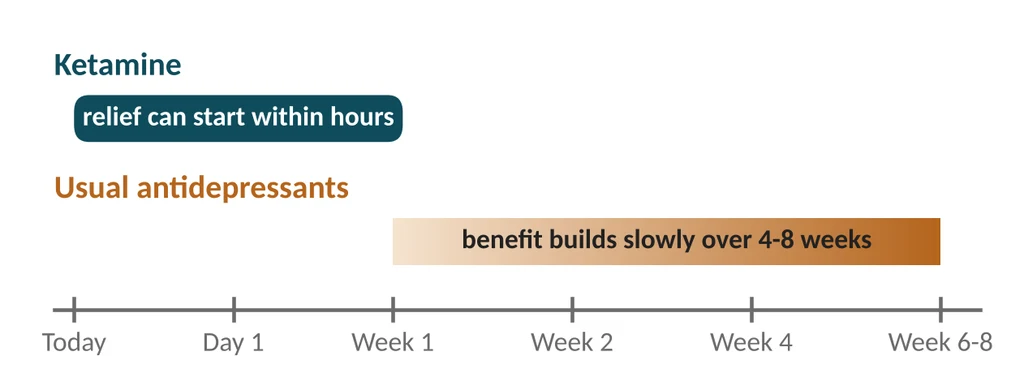
Ketamine vs usual antidepressants: how quickly they work
- Used in surgery since the 1960s. It is on the World Health Organization’s list of essential medicines.
- Psychiatry uses a much smaller dose. You stay awake.
- The effects last about 40-90 minutes, then wear off.
How it works, in 4 steps
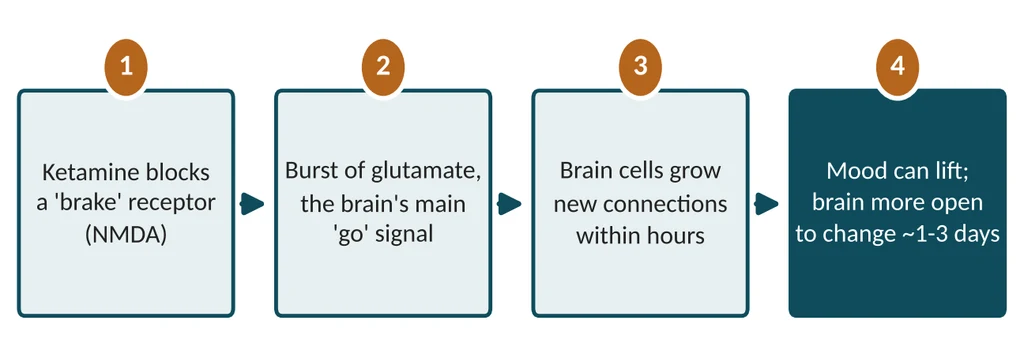
Usual antidepressants act on serotonin. Ketamine acts on glutamate – a different system.
Two forms you may hear about
| Ketamine | Esketamine (Spravato) | |
| How it is given | Drip into a vein, injection into a muscle, lozenge or tablet | Nasal spray |
| Approved? | “Off-label” for depression: legal and common, not formally licensed for it | Approved for treatment-resistant depression; clinic only, 2 hours observation |
What is ketamine-assisted psychotherapy?
| In Short: KAP = ketamine + therapy before, during and after. |
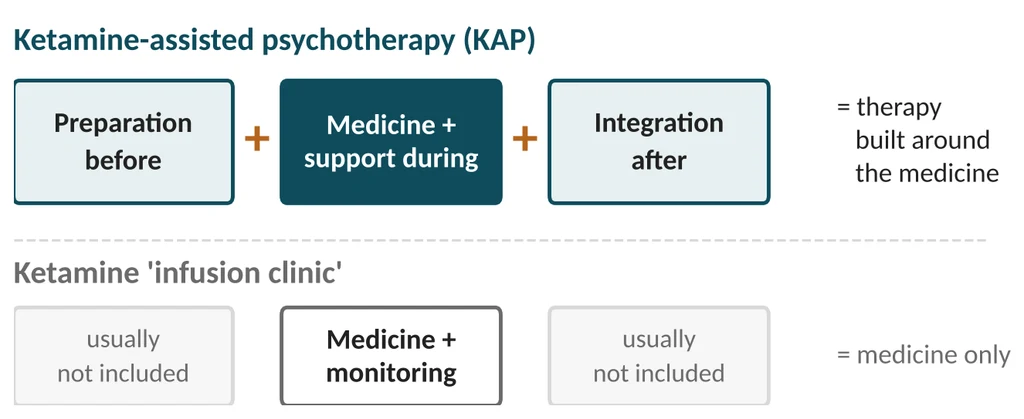
KAP compared with a medicine-only ketamine clinic
Why add therapy?
- Ketamine loosens “stuck” thinking – rumination, harsh self-criticism, the same thoughts on repeat.
- It opens a short window (about 1-3 days) when the brain changes more easily.
- Therapy helps you use that window to build new habits and ways of seeing things.
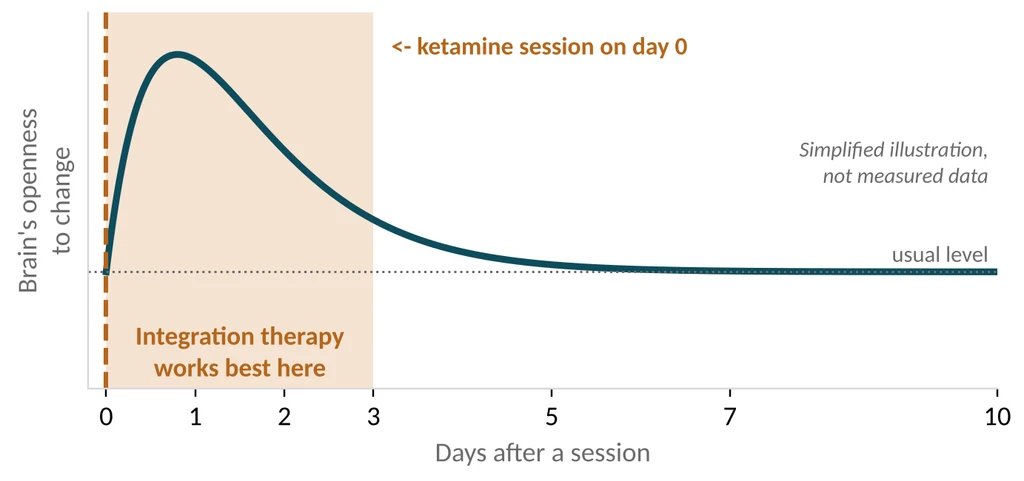
The “window” after a session, and where integration therapy fits
Two common styles
| Lower-dose sessions | Higher-dose sessions |
| You can talk; therapy happens during the session | Inward and dream-like; talking happens afterwards |
How is it done?
| In short: Assessment, then preparation, then 3-6 sessions each followed by integration, then a review |
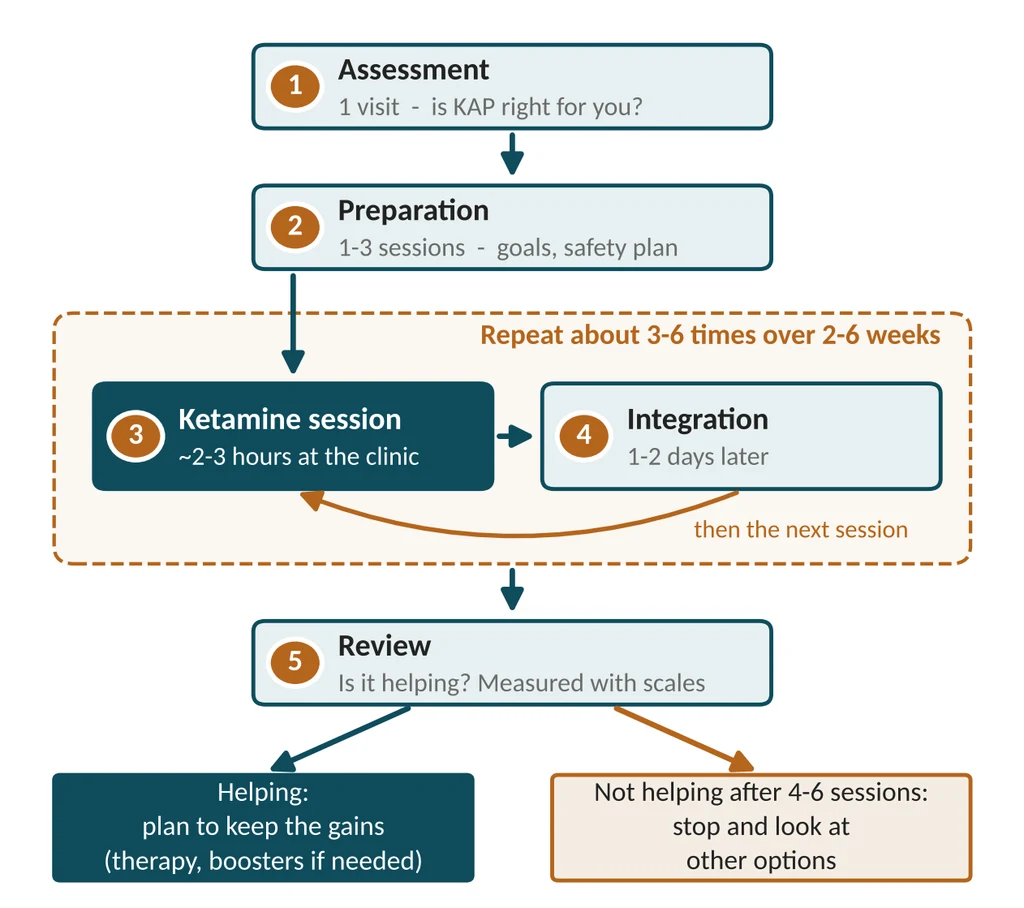
Your KAP journey, step by step
| Step | What happens | How long |
| 1. Assessment | Psychiatrist checks your diagnosis, past treatments, health, medicines, alcohol and drug use.Blood pressure check. Sometimes ECG, blood or urine tests. | 1 visit |
| 2. Preparation | Set goals with your therapist.Learn what to expect and how to stay steady.Agree a safety plan. Sign consent. | 1-3 sessions |
| 3. Ketamine session | Medicine given in a quiet room. A clinician stays with you. Blood pressure and heart rate checked. | 2-3 hours |
| 4. Integration | Make sense of the experience.Turn it into real changes in daily life. | 1-2 days after each session |
| 5. Review | Is it helping? Measured with rating scales.If not after 4-6 sessions, it is reasonable to stop. | After the course |
What a session day looks like
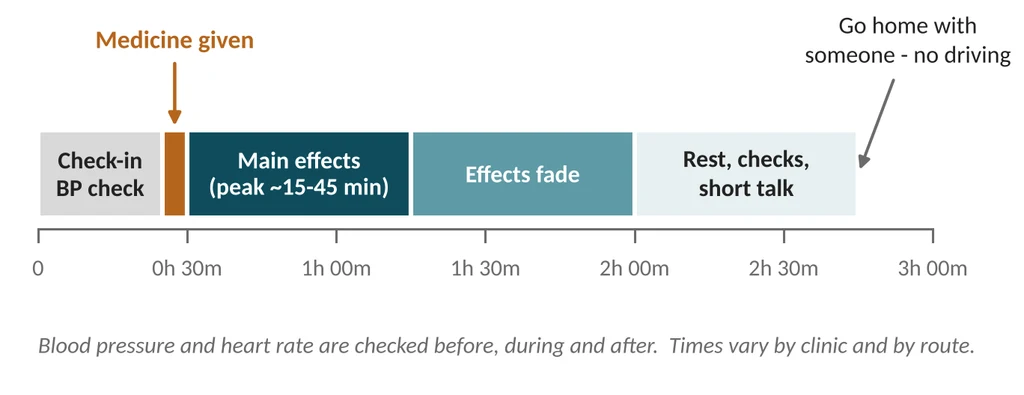
A typical session day (about 2.5-3 hours)
Ways the medicine can be given: a drip into a vein (usually over 40 minutes), an injection into a muscle, a lozenge dissolved in the mouth, or a nasal spray.
Your session-day checklist
| In short: Light stomach, a ride home, no alcohol, and tell us about every medicine you take. |
Before the day
- Tell your doctor about all your medicines and supplements. Some (for example clonazepam, alprazolam, lamotrigine) can weaken ketamine’s effect.
- Do not stop any medicine on your own.
- Arrange someone to take you home. You cannot drive until the next day.
- Clear your schedule for the rest of the day.
On the day
- Eat only lightly and stop eating a few hours before (your clinic will tell you exactly when). Nausea is common.
- No alcohol, cannabis or sleeping pills.
- Wear comfortable clothes. Bring eyeshades or headphones if you like.
- Tell the team if you feel unwell, very anxious, or have a headache before starting.
After the session
- No driving, machinery or big decisions until the next day.
- Rest. Write down anything that felt important, to bring to integration.
- Go to your integration session within 1-2 days.
What does it feel like?
| In short It can feel strange, dream-like or emotional. It is temporary, and you are watched over the whole time. |
Common feelings during a session
- Floating, or feeling detached from your body.
- Time feels different – slower, faster, or hard to track.
- Changes in sight and sound, and dream-like images.
- Strong emotions or memories may come up. This can be part of the therapy.
Side effects at a glance
| Common and short-lived | Uncommon but important – tell us |
| Feeling unreal or detached (expected) | Craving ketamine or wanting more sessions than planned |
| Dizziness, Nausea or vomiting | Bladder problems – pain, urgency, blood in urine |
| Headache, blurred vision | Memory problems (mainly with heavy recreational use) |
| Drowsiness | Hearing or seeing things, or very high mood afterwards |
| Short rise in blood pressure and pulse | |
| Feeling anxious or overwhelmed |
| Remember: Most side effects are gone within 2 hours. The long-term effects of repeated sessions over many years are not yet well studied. |
Who might benefit?
| In short: Best evidence: depression that has not improved after trying 2 or more antidepressants. |
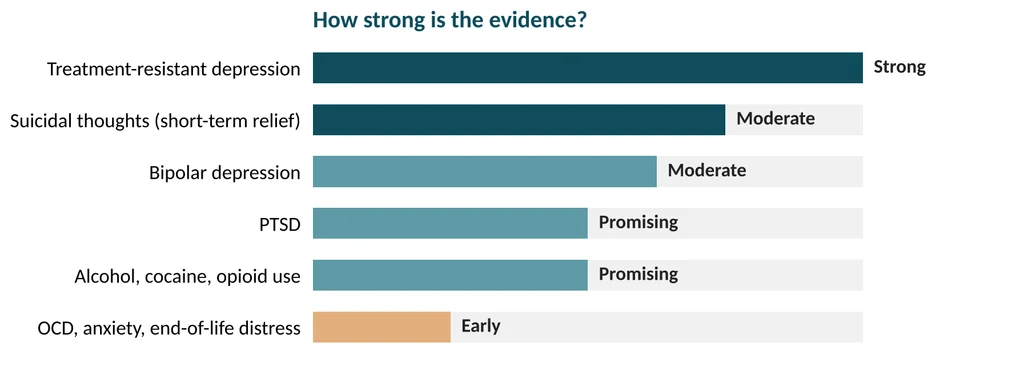
Evidence strength by condition (simplified)
- Treatment-resistant depression: many randomised trials. This is the main reason ketamine is used.
- Suicidal thoughts: relief within hours to days. Must be part of supervised crisis care.
- Bipolar depression: can help, but mood must be watched for a switch into mania.
- PTSD and addiction: promising, but studies are small.
| Remember: KAP is not a first step for mild or moderate depression or anxiety. Usual therapy and medicines come first. |
Who should not have it?
| In short: Screening is there to keep you safe. For some people, the risks outweigh the benefits. |
| STOP: usually not suitable | CAUTION: needs specialist judgement |
| Uncontrolled high blood pressure Recent heart attack or stroke Aneurysm or bleeding in the brain Schizophrenia, psychosis, or current psychotic symptoms Current mania or hypomania Pregnancy or breastfeeding Current misuse of ketamine or similar drugs Past serious reaction to ketamine | Heart disease Poorly controlled thyroid disease Severe liver disease Raised pressure in the brain or eye (e.g. glaucoma) Past substance use disorder Bladder problems Older age Crisis needing hospital care first |
Does it work? What the research shows
| In short: About half of people with hard-to-treat depression improve clearly. Without repeat sessions and ongoing care, the effect often fades. |
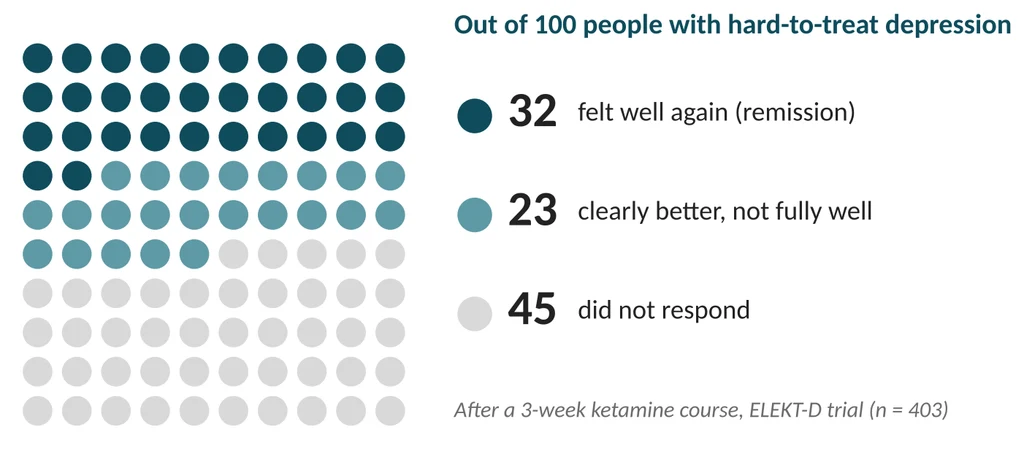
Response rates explained with 100 people (ELEKT-D trial)
“n” is the number of patients in a study. “Response” = symptoms down by at least half. “Remission” = symptoms down to a minimal level.
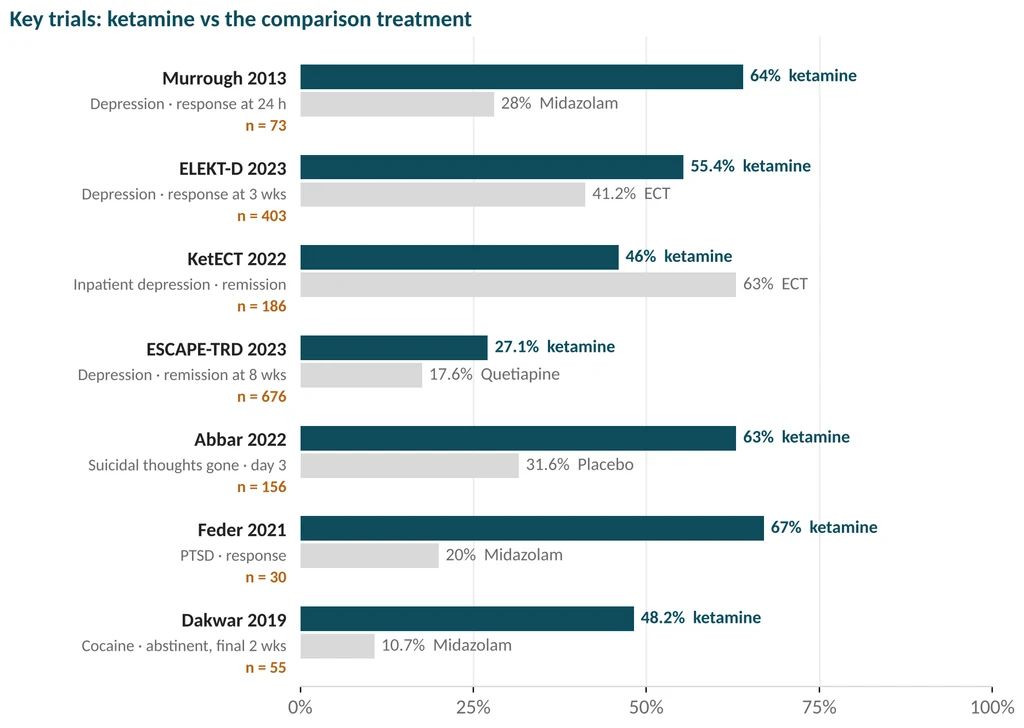
Ketamine usually beats the comparison treatment – but not always (ECT did better in KetECT)
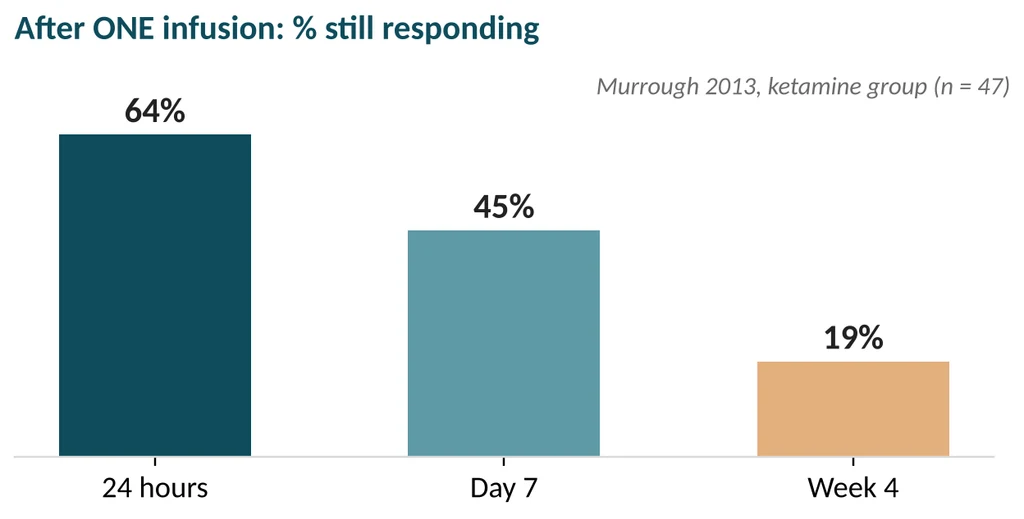
Why one session is rarely enough
Repeat dosing helps. In a trial of ketamine tablets (Glue 2024, n = 168), people who kept taking ketamine relapsed less: 43% vs 71% on placebo over 12 weeks.
Studies that combined ketamine with therapy
| Study | n | Who | Result |
| Krupitsky 2002 | 70 | Heroin dependence | Higher ketamine dose + therapy: more people stayed off heroin over 2 years |
| Krupitsky 2007 | 59 | Heroin dependence | 3 sessions vs 1: 50% vs 22% off heroin at 1 year |
| KARE, Grabski 2022 | 96 | Alcohol use disorder | Ketamine + therapy group stayed sober on 86% of days over 6 months |
| Dakwar 2019 | 55 | Cocaine dependence | With mindfulness therapy: 48% vs 11% cocaine-free in the final 2 weeks |
| Dore 2019 | 235 | Mixed, private clinics | Depression and anxiety improved – but no comparison group |
| Honest caveats Most big trials tested ketamine alone, not KAP. Studies of ketamine + therapy are smaller, so the added value of therapy is likely but not yet proven. Expectation matters. In a Stanford trial (Lii 2023, n = 40), patients got ketamine or salt water while asleep under anaesthesia. Both groups improved equally. So the setting and support around the medicine matter too. |
Myths vs facts
| In short: Most worries about ketamine come from recreational use, which is very different from medical treatment. |
| MYTH | FACT |
| “It’s a party drug, so it’s dangerous.” | Recreational use is frequent, high-dose and unsupervised. Medical use is measured, spaced out and monitored. The risk is real but much lower. |
| “One session will fix me.” | One dose usually helps for days, not months. Most people need several sessions plus ongoing care. |
| “It works for everyone.” | About half respond. Some feel no benefit at all. |
| “A stronger trip works better.” | For depression, how intense the experience is does not reliably predict how well it works. |
| “I can stop my other treatment.” | KAP is usually added to your care. Stopping medicines suddenly can cause relapse. |
| “It’s the same as magic mushrooms.” | Ketamine is a different type of drug. It works on a different brain system and the effects are shorter. |
| “Every ketamine clinic is approved.” | Only esketamine nasal spray is formally approved for depression. Clinic standards vary a lot. |
What KAP is – and what it is not
| In short: KAP can open a door. Walking through it still takes time, therapy and support. |
| KAP is | KAP is not |
| A medical treatment with screening and monitoring | Recreational, a party, or a retreat |
| A way to lift symptoms and create room for change | A cure |
| Usually for hard-to-treat conditions | A first-line treatment |
| Part of a wider care plan | A substitute for emergency or crisis care |
| Guided by a therapist who supports you | Mind control or a “truth serum” |
| Backed by evidence for depression | Proven for ADHD, burnout, weight loss or “wellness” |
| Given in a clinic with follow-up | Something to take at home without close medical follow-up |
Questions to ask, and when to get help
| In short: Know who is treating you, what is included, and how success will be measured. |
Questions to ask the clinic
- Who is the psychiatrist, and who stays with me during the session?
- Which form, which route, and how many sessions?
- Is therapy included? What are the therapist’s qualifications?
- How is my safety monitored? What if something goes wrong?
- How will we know it is working, and when do we stop if it is not?
- What is the plan after the course, and the total cost?
| Get help urgently if you have: Thoughts of harming yourself that feel hard to resist, or a plan to act. Confusion, hearing or seeing things, or agitation that has not settled a few hours after a session. Chest pain, severe headache, or new weakness or numbness. Pain or blood when passing urine, or new urgency. Contact the clinic or your nearest emergency department straight away. |
Key references
Abbar M, et al. Ketamine for the acute treatment of severe suicidal ideation: double blind, randomised placebo controlled trial. BMJ. 2022;376:e067194. (n = 156)
Anand A, et al. Ketamine versus ECT for nonpsychotic treatment-resistant major depression (ELEKT-D). N Engl J Med. 2023;388(25):2315-2325. (n = 403)
Dakwar E, et al. A single ketamine infusion combined with mindfulness-based behavioral modification to treat cocaine dependence. Am J Psychiatry. 2019;176(11):923-930. (n = 55)
Dore J, et al. Ketamine assisted psychotherapy (KAP): patient demographics, clinical data and outcomes in three large practices. J Psychoactive Drugs. 2019;51(2):189-198. (n = 235)
Ekstrand J, et al. Racemic ketamine as an alternative to electroconvulsive therapy for unipolar depression (KetECT). Int J Neuropsychopharmacol. 2022;25(5):339-349. (n = 186)
Feder A, et al. A randomized controlled trial of repeated ketamine administration for chronic posttraumatic stress disorder. Am J Psychiatry. 2021;178(2):193-202. (n = 30)
Glue P, et al. Extended-release ketamine tablets for treatment-resistant depression. Nat Med. 2024;30(7):2004-2009. (n = 168 randomised)
Grabski M, et al. Adjunctive ketamine with relapse prevention-based psychological therapy in the treatment of alcohol use disorder (KARE). Am J Psychiatry. 2022;179(2):152-162. (n = 96)
Krupitsky E, et al. Ketamine psychotherapy for heroin addiction: immediate effects and two-year follow-up. J Subst Abuse Treat. 2002;23(4):273-283. (n = 70)
Krupitsky EM, et al. Single versus repeated sessions of ketamine-assisted psychotherapy for people with heroin dependence. J Psychoactive Drugs. 2007;39(1):13-19. (n = 59)
Lii TR, et al. Randomized trial of ketamine masked by surgical anesthesia in patients with depression. Nat Ment Health. 2023;1:876-886. (n = 40)
Murrough JW, et al. Antidepressant efficacy of ketamine in treatment-resistant major depression: a two-site randomized controlled trial. Am J Psychiatry. 2013;170(10):1134-1142. (n = 73)
Reif A, et al. Esketamine nasal spray versus quetiapine for treatment-resistant depression (ESCAPE-TRD). N Engl J Med. 2023;389(14):1298-1309. (n = 676)
This guide is general information to support a conversation with your psychiatrist. It does not replace an individual assessment.